What 1,059 Questions Across Ten M&A Tasks Tell Us About the Value of a Reference Model
Most M&A teams still treat due diligence and post-merger integration as a mosaic of checklists that live in the heads of a few senior partners. Every deal starts more or less from scratch: someone opens last year's Word template, a junior analyst re-invents the working-capital tab, and half of the questions to management get lost between the data room and the SPA.
A reference model changes that. It captures — in a structured, machine-readable way — which tasks belong in an M&A process, which questions each task needs to ask, and which data objects it needs to collect. Below is a snapshot of the ten most content-heavy tasks in my reference model, ranked by number of questions.
The ten tasks
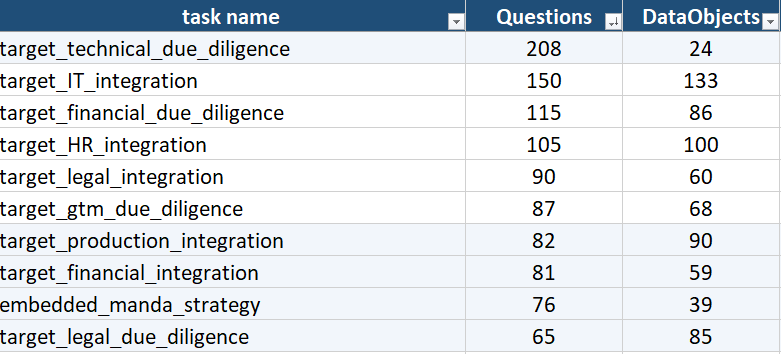
Ten tasks. 1,059 structured questions and 744 data objects — every single one of them re-usable across deals.
What the numbers actually say
A few patterns jump out once you look past the totals.
Technical due diligence is question-heavy, but object-light. 208 questions against only 24 data objects means Tech DD is dominated by qualitative probing — architecture decisions, engineering culture, technical debt, security posture — that resolves into a small number of consolidated artifacts (architecture map, tech stack inventory, risk register). The value sits in the questioning discipline, not in a sprawling data set.
IT integration is the opposite. 150 questions but 133 data objects. Integration work is a data-migration and systems-mapping exercise: every application, interface, license, and user group is its own object. If your model does not name them, your integration plan will not either.
HR and production integration are object-dense. 100 and 90 objects respectively. Employees, contracts, pension schemes, sites, machines, BOMs — integration is where the target company's operational reality has to be represented one-to-one in the acquirer's world.
Legal DD is small on questions, large on objects. 65 questions, 85 data objects. Legal work is less about interrogation and more about collecting the right contracts, registrations, and IP records and checking them systematically.
Embedded M&A strategy sits on top. 76 questions, 39 objects. It is the smallest task by volume because it is a framing layer — it forces the deal team to connect the target back to the acquirer's corporate and portfolio strategy before diligence and integration begin.
Why this model creates value
Anyone can write a due diligence checklist. The value of a reference model is what happens once the checklist is structured.
1. Coverage becomes measurable. When Tech DD has 208 named questions, "we did technical due diligence" stops being a statement of faith. You can report a completion rate, flag unanswered questions as open risks, and defend scope decisions in front of an investment committee.
2. Diligence and integration stop being two separate worlds. In this model, target_financial_due_diligence (115 Q / 86 O) and target_financial_integration (81 Q / 59 O) share the same data-object vocabulary. Findings from the diligence phase flow directly into the integration plan instead of being re-discovered on day one after closing. The same holds for legal, HR, IT, GTM, and production.
3. Re-use compounds across deals. Each new transaction reuses 1,059 questions and 744 objects. Analysts stop rewriting question banks and start refining them. Senior partners' tacit knowledge — the "did you check X?" that used to live only in their heads — is captured as an explicit question or object in the model.
4. It is AI-ready. A structured task/question/object model is exactly the substrate that agentic AI, MCP servers, and LLM copilots need. Once questions and objects are declared as facts, you can auto-generate request lists, pre-fill answers from the data room, cross-check integration plans against DD findings, and route open items to the right expert. Freeform Word templates cannot do any of this.
5. It exposes gaps honestly. The numbers themselves are a diagnostic. A task with many questions but few data objects is a signal that findings are not being persisted. A task with many objects but few questions is a signal that data is being collected without an underlying analytical question. Both are fixable — but only once the model makes them visible.
The takeaway
A reference model is not a bigger checklist. It is a shared, structured language for the M&A process. In these ten tasks alone, it encodes over a thousand questions and nearly 750 data objects that every future deal team can inherit, extend, and, increasingly, hand to an AI agent to run against a live data room.
That is the difference between doing M&A deal by deal and running M&A as a repeatable, improvable, and automatable capability.
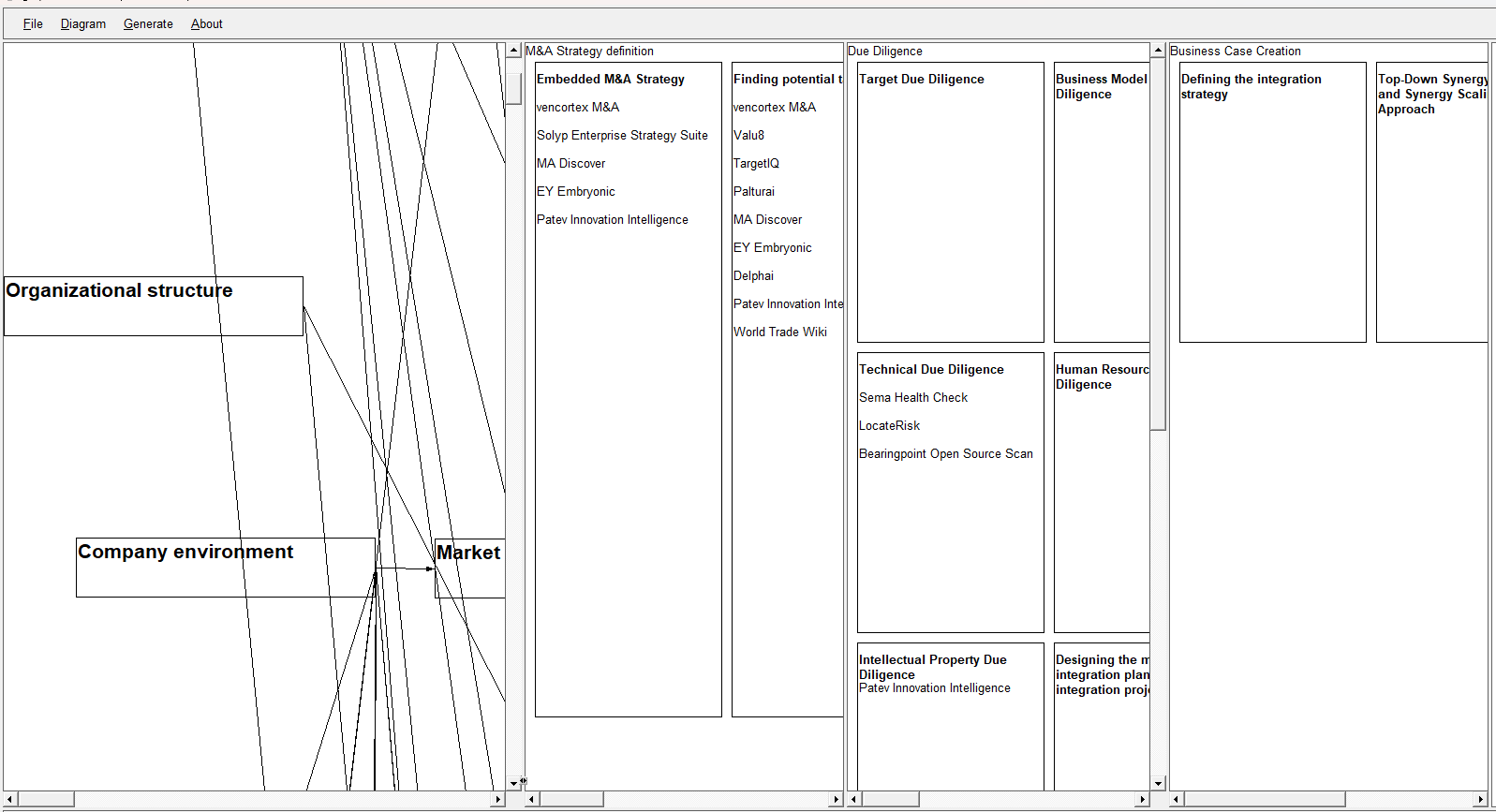
M&A Reference Model – Overview
The M&A Reference Model from M&A Automation is an end‑to‑end domain model of the entire mergers and acquisitions lifecycle, spanning from strategy creation through due diligence to post‑merger integration. It specifies the M&A process in a formal, structured way, combining a process model with a rich data model so that every phase can be consistently documented, analyzed, and ultimately automated. The model breaks M&A work into clearly defined tasks (e.g., Embedded M&A Strategy, Finding Potential Targets, Processing the Long and Short List), each with explicit goals, objectives, and classifications such as whether it is a decision or execution task and whether the problem is structured or unstructured. This creates a holistic blueprint that helps organizations move from ad‑hoc dealmaking toward repeatable, systematic M&A execution with shared language and expectations across strategy, finance, legal, and integration teams.
Under the hood, the M&A Reference Model is also a large knowledge base and automation enabler: it defines dozens of roles, hundreds of tasks, over two thousand guiding questions, and a comprehensive data model with hundreds of data objects that are all linked to the tasks that use them. For each task, it specifies required data, typical roles involved, detailed action steps, and extensive question catalogs that guide analysis and decision‑making, while also mapping which actions can be fully, partially, or not yet automated and which M&A tools and technologies (such as analytics, NLP, or AI assistants) are relevant. Tool vendors can license the model as a standardized domain and API layer to build interoperable solutions on top of a common process and data foundation, while M&A teams can use it as a checklist, design template, and analytics engine to assess capabilities, identify gaps, and drive continuous improvement in how they plan and execute acquisitions.
Price will be charged on a yearly basis in this subscription. Data are provided in a JSON file containing information about 70 tasks with 2200 assigned questions and an overarching data model containing 950 data objects, which are also assigned to tasks.
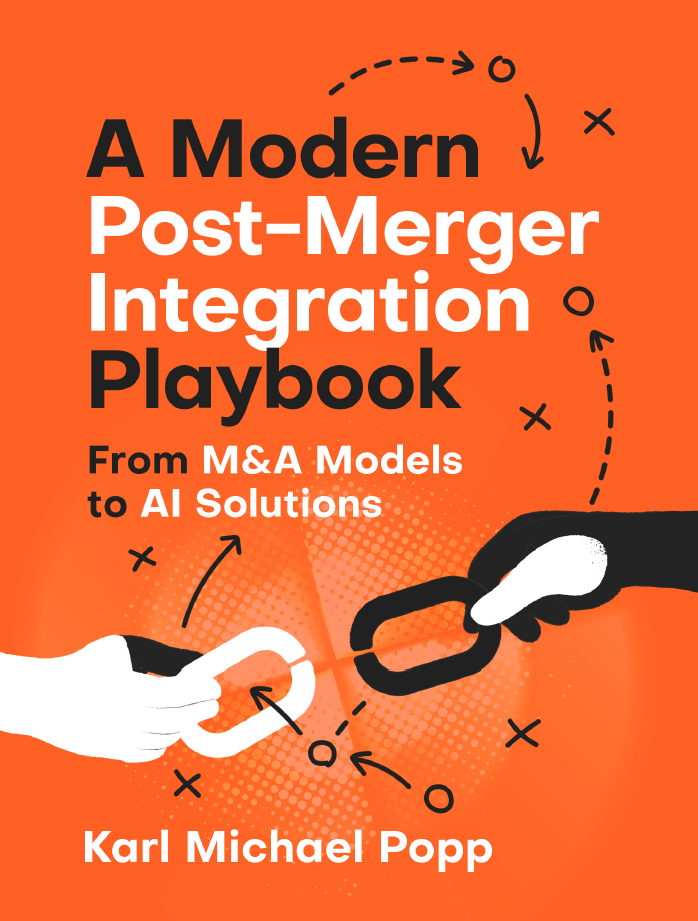
A Modern Post-Merger Integration Playbook: From M&A Models to AI Solutions
By Dr. Karl Michael Popp
Master integration due diligence to transform your M&A success. Learn more at manda-automation.com