The Invisible Job That Keeps an M&A Strategy Phase on Track
Every acquisition has a glamorous beginning — the vision, the target wish-list, the synergy story told to the board. What it rarely has is someone making sure that beginning actually happens on time, on budget, and without quietly drifting off course. That someone is doing Strategy Phase Project Management, and it's one of the most underrated tasks in the entire M&A lifecycle.
What the task is
Strategy Phase Project Management is the control-and-monitoring layer over everything that happens during the M&A strategy phase. The task owner triggers each strategy-phase task at the right time, watches execution on a regular cadence, and intervenes the moment things deviate from plan or conflicts emerge. When a workstream slips, a dependency breaks, or two stakeholders pull in opposite directions, this is the role that brings about a fix.
Formally, it's a structured decision task owned by the M&A Lead of the buyer. Its goal is a planned buyer M&A strategy, pursued under four objectives that define good M&A governance: minimize information asymmetry, maximize quality, minimize risk, and maximize synergy. In other words, it isn't about doing the strategy work — it's about making sure the strategy work gets done well.
Why it matters more than it looks
The strategy phase sets the trajectory for the entire deal. Decisions made here — which targets to pursue, what the deal thesis is, how synergy will be created — constrain everything that follows. If this phase runs late, runs over budget, or produces a half-baked strategy, no amount of brilliant due diligence later can fully recover the loss.
Project management is the difference between a phase that converges on a clear, board-ready strategy and one that meanders until a deadline forces a rushed decision. The task exists precisely because intent doesn't execute itself. Someone has to own the calendar, the budget, the risks, and the awkward conversations.
Where thin versions of this task fall short
In practice, many strategy-phase plans describe the intent to monitor without defining the mechanism. They say the owner "monitors regularly and intervenes on deviations" — but never specify the cadence, the status-report format, the KPIs, or the variance thresholds that should actually trigger an intervention. A monitor with no instruments is just an optimist.
A robust version of the task adds the machinery that makes control real:
A baseline plan covering scope, schedule, milestones, budget, resources, and a RACI matrix.
A defined monitoring cadence and KPIs — schedule variance, budget burn, milestone completion, open issues and risks.
A working issue, change, and decision-management process, backed by a risk register, issue log, decision log, and action-item tracker.
A stakeholder register and communication plan so people know who communicates what, when, and to whom.
A phase-gate go/no-go decision that formally closes the strategy phase and hands over to due diligence.
The synergy and scope traps
Two subtle issues deserve attention. First, "maximize synergy" often sits in the objectives as an orphan — declared but never tracked. A strong task captures early synergy hypotheses during the strategy phase and hands them to due diligence for validation, rather than letting them evaporate between phases.
Second, scope discipline matters. It's easy for a strategy-phase task to quietly fill up with due-diligence-phase artifacts and questions, blurring two distinct phases. Keeping the objects and questions correctly scoped — strategy phase here, due diligence downstream — is what keeps governance clean and handovers crisp.
The bottom line
Strategy Phase Project Management is the unglamorous discipline that turns strategic ambition into executed reality. It doesn't generate the deal thesis; it makes sure the thesis gets built on time, surfaces risks before they become surprises, and ends the phase with a defensible go/no-go decision. Acquirers who treat it as real project management — with baselines, KPIs, and decision gates — move faster and with more confidence. Those who treat it as a status meeting find out, too late, that monitoring without mechanism is just watching things go wrong in real time.
Dr. Karl Michael Popp is an M&A expert and author specializing in software company acquisitions.Contact: +49 6202 5829917 | www.drkarlpopp.com
Parts of this blog might be AI generated
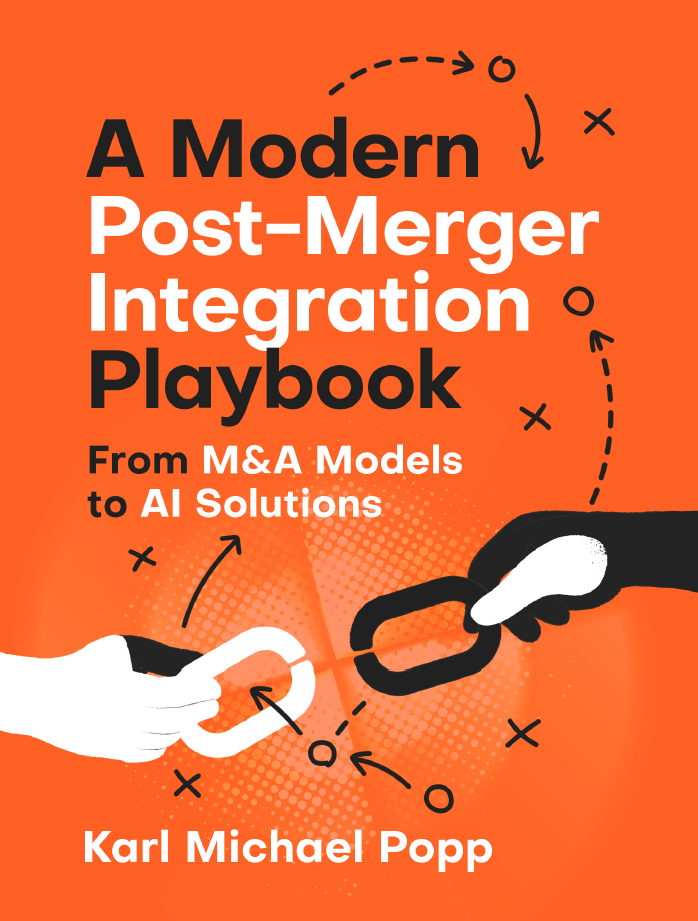
A Modern Post-Merger Integration Playbook: From M&A Models to AI Solutions
By Dr. Karl Michael Popp
Master integration due diligence to transform your M&A success. Learn more at manda-automation.com