M&A Strategy: where is the automation? (part two, key takeaways)
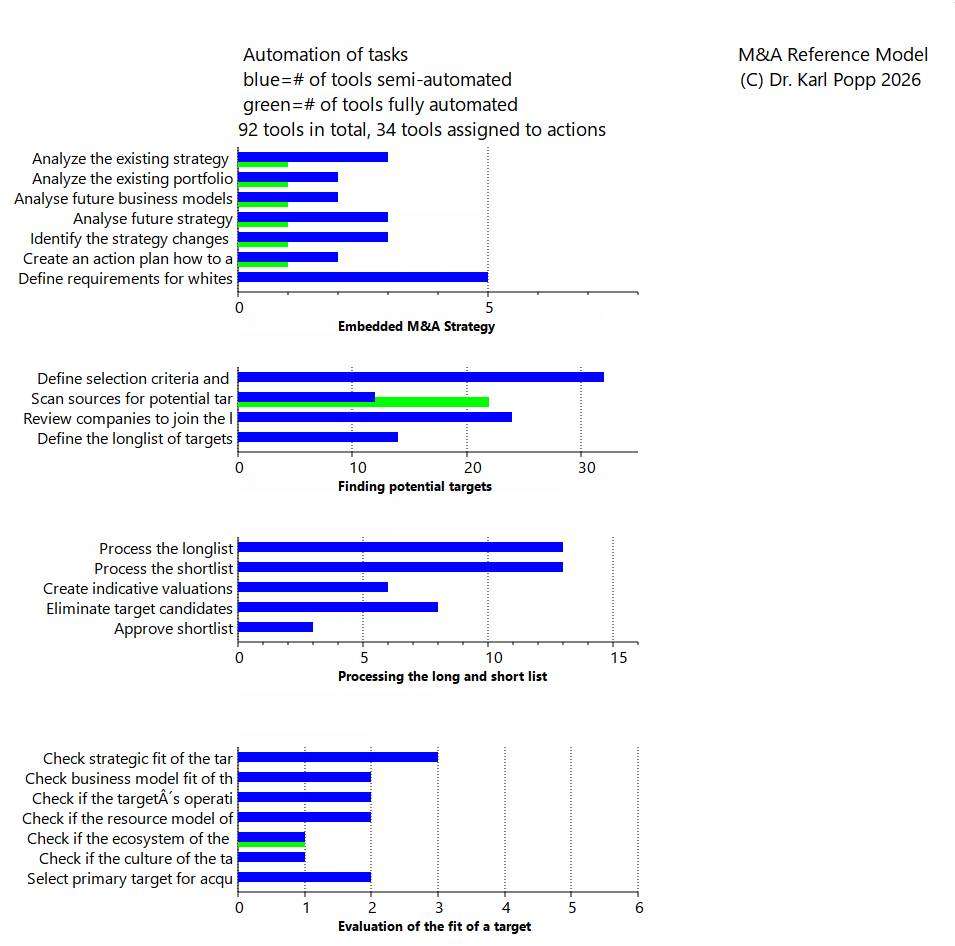
A new analysis based on the M&A Reference Model (C) Dr. Karl Popp 2026 — covering 92 tools in total, with 34 assigned to specific M&A strategy activities — provides a data-driven answer. The model maps tool coverage across four major tasks and distinguishes between two levels of automation: semi-automated activities (where a tool assists but a human still drives the process) and fully automated activities (where a tool can execute the task end-to-end without significant human intervention).
The findings reveal a clear pattern: automation is heavily concentrated in the middle of the M&A strategy phase— particularly in target identification and list management — while strategic planning at the front end and qualitative fit assessments at the back end remain largely manual.
Key Takeaways for M&A Practitioners and Technology Evaluators
The M&A Reference Model data tells a coherent story about where the software market has concentrated its energy — and where it has not.
Automation is strongest in target identification and list management. The combination of 33 tools for defining selection criteria and 8 tools that fully automate source scanning suggests that deal origination has become the most technologically mature phase of the M&A lifecycle.
Strategic context and cultural judgment remain human domains. With tool counts in the range of one to four across nearly all activities in the Embedded Strategy and Target Fit groups, the data confirms that software has not meaningfully penetrated the qualitative, judgment-heavy work at either end of the process.
There is a tool gap at approval and governance checkpoints. The near-absence of tools for "Approve shortlist" highlights an underdeveloped area — one where workflow automation, audit trails, and structured documentation could add real value for larger deal teams.
For organizations evaluating their M&A technology stack, the model provides a useful diagnostic lens. If your team is spending disproportionate time on list management, strong tool support exists. If the bottleneck is strategic alignment or cultural assessment, technology is unlikely to be the answer — at least for now.
Here is a graphical overview:
3. Processing the Long and Short List: Solid but Narrowing Coverage
As the M&A process moves from a broad universe to a filtered shortlist, tool support remains meaningful but begins to contract.
"Process the longlist" and "Process the shortlist" each have 13 semi-automated tools — indicating that structured evaluation workflows, scoring frameworks, and collaboration features are well supported by the vendor ecosystem. "Eliminate target candidates" attracts 8 tools, and "Create indicative valuations" six.
The drop-off at the final stage is striking: "Approve shortlist" has only three tools assigned to it. This reflects the reality that formal approval gates are governance events — typically requiring board or executive sign-off — where workflow orchestration tools exist but dedicated M&A software plays a limited role.
4. Evaluation of Target Fit: A Return to Manual Assessment
The fourth task group covers the qualitative and strategic evaluation that follows shortlist approval: assessing strategic fit, business model alignment, operating model compatibility, resource fit, ecosystem positioning, and cultural compatibility.
Tool coverage drops back to the levels seen in the strategy group. "Check strategic fit of the target" has roughly four semi-automated tools. Most other fit checks — business model, operating model, resource model — attract only one to two tools each.
The cultural and ecosystem dimensions are particularly thin. "Check if the culture of the target fits" and "Check if the ecosystem of the target fits" each have approximately one tool (with ecosystem fit also showing one fully automated tool). This scarcity is consistent with how M&A practitioners describe these assessments in practice: they depend on interviews, management observations, and contextual judgment that are difficult to encode into software logic.
A Modern Post-Merger Integration Playbook: From M&A Models to AI Solutions
By Dr. Karl Michael Popp
Master integration due diligence to transform your M&A success. Learn more at manda-automation.com