M&A Strategy: where is the automation? (part one)
A new analysis based on the M&A Reference Model (C) Dr. Karl Popp 2026 — covering 92 tools in total, with 34 assigned to specific M&A strategy activities — provides a data-driven answer. The model maps tool coverage across four major tasks and distinguishes between two levels of automation: semi-automated activities (where a tool assists but a human still drives the process) and fully automated activities (where a tool can execute the task end-to-end without significant human intervention).
The findings reveal a clear pattern: automation is heavily concentrated in the middle of the M&A strategy phase— particularly in target identification and list management — while strategic planning at the front end and qualitative fit assessments at the back end remain largely manual.
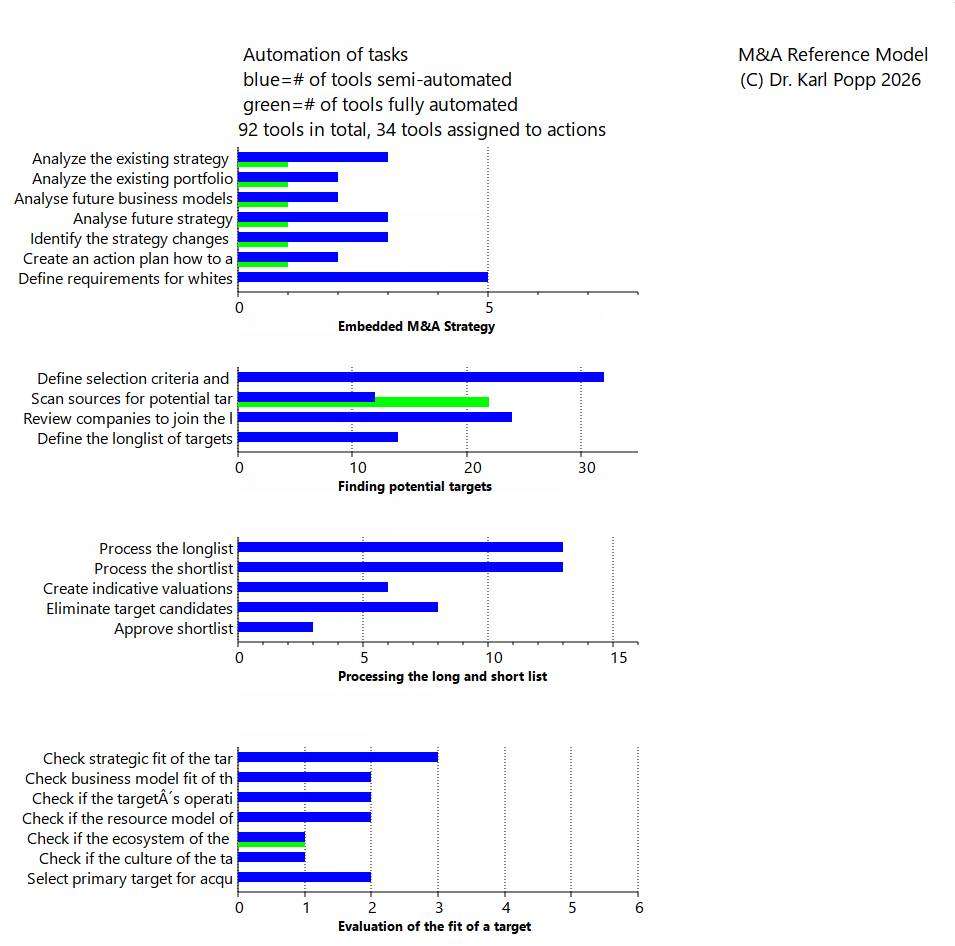
Here is a graphical overview:
1. Embedded M&A Strategy: Light Automation at the Foundation
The first task covers activities that define the strategic intent behind an M&A program: analyzing the existing portfolio and corporate strategy, modeling future business scenarios, identifying strategic gaps, and defining requirements for target "whitespace."
Tool support here is modest. Only a maximum of 5 tools from 34 tools overall cover activities in this task. Activities such as "Analyze the existing strategy," "Analyze the existing portfolio," and "Analyse future strategy" each attract around three to four semi-automated tools, with one tool offering full automation in each case. "Define requirements for whitespace" stands out slightly as the most-covered activity in this group, with approximately five semi-automated tools.
This limited coverage is not surprising. These are fundamentally judgment-intensive tasks that require deep contextual knowledge of a company's competitive position, management priorities, and market dynamics. Software can support data aggregation and scenario modeling, but the strategic synthesis remains a human responsibility.
2. Finding Potential Targets: Where Automation Peaks
The second task group is where tool support surges dramatically — and where the most striking data point in the entire model appears.
"Define selection criteria and filters" has 32 tools assigned to it — the single highest figure across all 22 activities in the model. This reflects the proliferation of target-screening platforms that allow users to configure financial, geographic, industry, and growth-stage filters to narrow a universe of potential acquisition candidates.
Close behind, "Review companies to join the longlist" draws 24 semi-automated tools, and "Define the longlist of targets" 14.
Equally notable is the green bar for "Scan sources for potential targets," which has the highest number of fully automated tools in the chart — approximately 8. This makes intuitive sense: source scanning involves monitoring databases, news feeds, and proprietary deal networks at a frequency and scale that humans cannot match alone. Automation here is genuinely high-value, and the market has responded accordingly.
Stay tuned for part two of this blog post.
A Modern Post-Merger Integration Playbook: From M&A Models to AI Solutions
By Dr. Karl Michael Popp
Master integration due diligence to transform your M&A success. Learn more at manda-automation.com