Mergers and AI: The Future of Merger Integration Automation
How Artificial Intelligence Is Transforming M&A
The Next Frontier: AI Agents in M&A
Imagine an M&A process where artificial intelligence agents handle routine tasks, coordinate between departments, ensure nothing falls through the cracks, and flag emerging risks before they become problems. This isn't science fiction anymore—it's becoming reality.
As Dr. Karl Popp explores in his integration playbook's concluding chapter, AI and intelligent automation are poised to transform how organizations approach merger integration. Understanding this transformation is critical for organizations looking to maintain competitive advantage in M&A execution.
Why AI in M&A?
M&A integration involves hundreds of tasks, thousands of decisions, and massive coordination challenges. Much of this work is repetitive, rule-based, and data-intensive—exactly the type of work that artificial intelligence handles well.
Routine Task Automation:
- Document review and due diligence analysis
- Data consolidation and reconciliation
- Status reporting and dashboard updating
- Compliance checking and regulatory requirement verification
- Template generation and document automation
Coordination and Tracking:
- Ensuring dependent tasks execute in proper sequence
- Tracking task progress and identifying delays
- Escalating issues requiring executive attention
- Consolidating status from multiple workstreams
Knowledge Management:
- Capturing integration lessons learned
- Identifying best practices from past integrations
- Applying lessons to current integration planning
- Documenting decisions and rationale
Risk Identification:
- Monitoring integration metrics for emerging issues
- Comparing actual progress to plan, identifying variances
- Flagging risk conditions before they escalate
- Analyzing interdependencies for potential cascading failures
Types of AI Agents in M&A
Dr. Popp's framework identifies different types of agents appropriate for different M&A functions:
Task Agents
Task agents handle specific, well-defined tasks:
Examples:
- Due diligence document analyzer: Reads and analyzes M&A due diligence documents, extracting key risks and concerns
- Financial consolidation agent: Consolidates financial data from multiple systems, produces consolidated financial statements
- Regulatory compliance agent: Checks compliance against regulatory requirements, identifies gaps
- Contract review agent: Reviews customer and supplier contracts, identifies terms requiring attention
Characteristics:
- Focused on single task or closely related tasks
- Execute based on defined rules and procedures
- Produce specific outputs
- Relatively easy to build and validate
Value:
- Automate high-volume, repetitive tasks
- Improve consistency and accuracy
- Free human experts for higher-value work
- Operate continuously without fatigue
Role Agents
Role agents simulate people in M&A roles, executing broader responsibilities:
Examples:
- Finance integration lead agent: Owns finance integration, coordinates with finance teams, ensures finance integration tasks proceed on schedule
- IT integration lead agent: Manages IT integration, coordinates system consolidation, escalates technical issues
- HR integration lead agent: Manages organizational integration, ensures talent retention plans execute, handles employee communication
- Integration manager agent: Coordinates across all workstreams, consolidates status, manages integration timeline
Characteristics:
- Handle complex responsibilities with multiple decision points
- Work across multiple domains (finance, IT, HR, operations)
- Interact with people and other agents
- Require sophisticated reasoning and judgment
- Still require human oversight for critical decisions
Value:
- Ensure consistent execution of complex processes
- Reduce burden on human leaders to manage coordination
- Operate 24/7 monitoring integration progress
- Provide consistent communication and status updates
Building AI Agent Systems for M&A
Moving from concept to reality requires clear architecture:
Understanding Automation Needs
Not all M&A work should be automated. First step is identifying which tasks are candidates for automation:
Automation Suitable Tasks:
- Highly structured, rule-based tasks (document review, compliance checking, status reporting)
- High-volume, repetitive tasks (data consolidation, template generation, basic analysis)
- Tasks requiring 24/7 monitoring (risk monitoring, dependency tracking)
Tasks Requiring Human Judgment:
- Strategic decisions about integration approach
- Conflict resolution requiring understanding of organizational context
- Cultural integration and change management
- Negotiation and stakeholder management
- Complex problem-solving in novel situations
Data Model and Integration
AI agents require rich data to operate effectively:
Data Elements:
- Due diligence documents and analyses
- Integration plan details and task definitions
- Organizational structures (both companies)
- Contract information (customer, supplier, employee)
- Financial and operational data
- Risk registers and issue logs
Data Integration:
- Integration of data from multiple systems (finance, HR, IT)
- Real-time data feeds for operational monitoring
- Document repositories for analysis
- Communication platforms for agent-human interaction
Agent Collaboration
Multiple agents working together require coordination:
Agent-to-Agent Communication:
- How task agents report results to role agents
- How role agents coordinate with each other
- Escalation protocols when agents identify issues
- Information sharing between agents
Agent-to-Human Collaboration:
- How agents present information to humans
- How humans provide direction to agents
- Decision-making protocols (when humans decide vs. agents decide)
- Feedback loops to improve agent behavior
The Implementation Pathway
Dr. Popp outlines a staged implementation approach:
Phase 1: Identify Automation Candidates Review M&A tasks and identify which are good candidates for automation. Start with high-volume, well-defined tasks.
Phase 2: Build Task Agents Develop task agents for automation candidates. Focus on well-defined, repeatable tasks with clear success criteria.
Phase 3: Integrate with Existing Systems Connect task agents to M&A systems—due diligence platforms, project management tools, financial systems, HR systems.
Phase 4: Build Coordination As task agents mature, build coordination—how agents share information, how they sequence work, how they escalate issues.
Phase 5: Develop Role Agents Build higher-level role agents that coordinate across multiple task agents and interact with human leaders.
Phase 6: Continuous Improvement Monitor agent performance, identify improvements, incorporate lessons learned. AI systems improve with feedback.
The Future of M&A
As AI capabilities advance, the role of AI in M&A will expand. Organizations that build AI capabilities now will have competitive advantage in M&A execution over those that don't.
The future M&A organization will be hybrid—AI agents handling routine work, executing coordination, monitoring progress, and flagging issues, while human experts focus on strategic decisions, conflict resolution, cultural integration, and stakeholder management.
Why This Matters
Understanding AI and agent-based systems in M&A isn't optional anymore—it's essential for organizations pursuing M&A strategy. The organizations that master this technology will execute integrations faster, more consistently, and with better outcomes than competitors.
Dr. Popp's integration playbook provides the structured foundation that AI systems need to operate effectively. As organizations transition from manual to AI-augmented M&A execution, frameworks like the integration playbook become increasingly valuable.
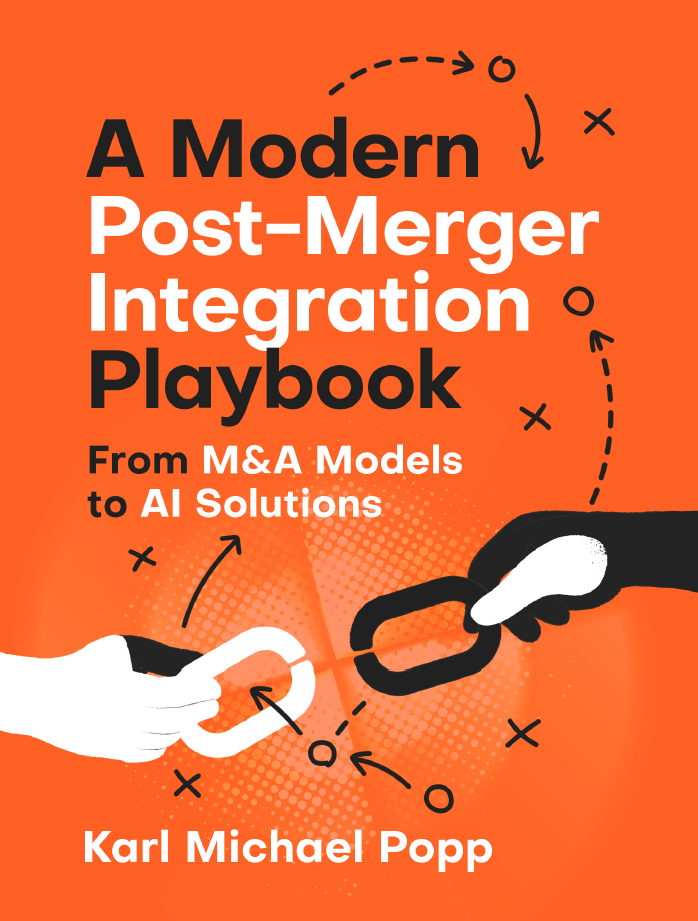
A Modern Post-Merger Integration Playbook: From M&A Models to AI Solutions
By Dr. Karl Michael Popp
Master integration due diligence to transform your M&A success. Learn more at manda-automation.com