Key components of a world model of the M&A process for artificial intelligence
In the realm of mergers and acquisitions, having precise information is crucial for sound decision-making. The M&A lifecycle encompasses complex interactions among various factors. Routine analysis faces obstacles in aligning with the quick growth of data speed and sheer amount. A comprehensive approach to AI modeling in the world helps to unify varied data, manage the unknown, and guide strategic decision-making throughout the deal lifecycle.
A world model serves as a probabilistic framework for understanding business dynamics and agent responses. It surpasses simple projections by incorporating causal links and dynamic variables that affect outcomes. In M&A, a well-developed world model allows AI to simulate scenarios, foresee risks, and suggest strategies aligned with objectives.
Key components of an M&A world model include:
Market and financial topology: A structured language connecting financial metrics and industry-specific dynamics.
Target and buyer profiles: Representations that encompass various organizational characteristics and historical performance.
Deal mechanics and constraints: Valuation and regulatory factors that vary with deal specifics and geographical context.
Information signals and uncertainty: Tools to address data imperfections and quantify confidence in financial projections.
Stakeholder reasoning: Models that illustrate stakeholder reactions to information and incentives, aiding in negotiation simulations.
Integration and value realization: Frameworks for managing post-merger integration and achieving synergies over time.
AI utilizes a world model in M&A through:
Scenario planning under uncertainty: Generating diverse future scenarios to evaluate different strategic options.
Risk-adjusted valuation and decision support: Combining market data with mechanics to inform risk-adjusted valuations and improve profiles.
Integration sequencing and execution planning: Optimizing integration processes and resource allocation to enhance value realization.
Regulatory and cultural risk forecasting: Identifying potential regulatory and cultural issues early to inform due diligence.
Continuous learning from outcomes: Updating the model with post-deal performance to enhance predictive capabilities.
Stay tuned for more blog posts on this topic.
Karl Popp leads the M&A Automation Initiative and the Arbeitskreis Digitalisierung within the Bundesverband M&A. He has developed a comprehensive M&A reference model covering the full deal lifecycle, used to assess automation readiness and tool integration across M&A processes.
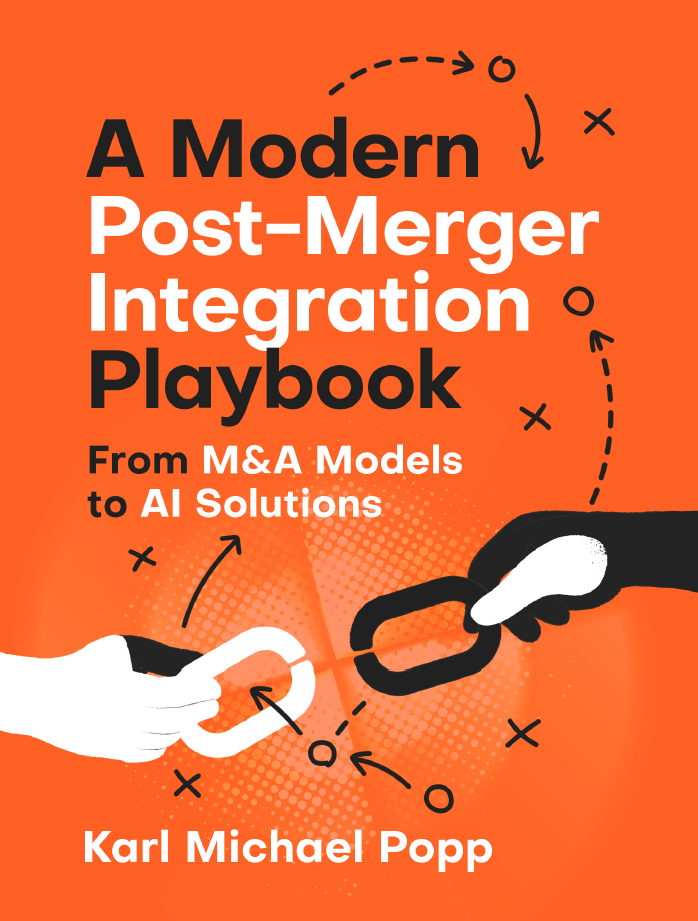
A Modern Post-Merger Integration Playbook: From M&A Models to AI Solutions
By Dr. Karl Michael Popp
Master integration due diligence to transform your M&A success. Learn more at manda-automation.com