How does artificial intelligence change intellectual property workflows?
Artificial intelligence (AI) is driving a major change in how intellectual property (IP) assets are developed, administered, and utilized. AI bridges human expertise and advanced data handling with pattern recognition, letting organizations streamline workflows, make more precise decisions, and reduce the time needed to launch new products and ideas. The article maps the primary areas where AI is altering IP operations, discusses the gains and hazards that come with it, and spells out crucial implementation points.
1) Invention and idea mining
AI-enabled tools can support inventors and researchers by reviewing extensive collections of scientific publications, patents, and non-patent literature to locate prior art, detect emerging trends, and uncover possible market gaps. Sophisticated language models and semantic search improve the specificity of disclosures, helping teams develop new concepts while lowering the likelihood of accidental infringement. For patent professionals, AI can retrieve relevant prior art more rapidly, strengthening claim support and informing more durable patent strategies.
2) Prior art search and patent landscaping
Conventional prior art searches are slow and can be affected by human error. AI moves the process along faster via machine learning that groups documents, recognizes commonalities, and estimates relevance. Patent landscaping tools help organizations map out technology directions, assess the competitive scene, and flag concerns tied to patentability and freedom-to-operate. As a result, organizations can make better-informed choices for research and development portfolios and licensing strategies.
3) Drafting and prosecution support
AI-assisted drafting software can produce initial patent claims, descriptions, and specification segments that conform to standards in the relevant jurisdictions. Although expert human supervision remains necessary, these tools can generate well-developed drafts, flag unclear terminology, and recommend claim amendments. During prosecution, AI can track office actions, highlight potential claim limitations, and suggest response approaches, thereby reducing both cycle times and the consumption of resources.
4) Trademark and brand management
In trademark work, AI strengthens brand monitoring, clearance searching, and conflict analysis. Natural language processing (NLP) can evaluate consumer perceptions and the risk of misidentification across different markets, while image and logo recognition algorithms can help identify unauthorized uses. AI-supported analytics promote portfolio optimization, enabling brands to safeguard their identity consistently across channels and to detect infringements earlier.
5) Copyright management and content monetization
For content creators and rights holders, AI accelerates content identification, rights clearance, and licensing workflows. Automated content recognition (ACR) technologies can monitor usage across platforms, helping ensure correct attribution and licensing. AI also facilitates royalty computation, rights aggregation, and contract administration, which increases transparency and lowers administrative workload.
6) Due diligence and risk assessment
In mergers, acquisitions, and licensing negotiations, AI can quickly compile and analyze IP portfolios, evaluate valuation drivers, and surface conditional risks such as ownership disputes or encumbrances. Predictive models help measure potential litigation exposure and estimate the probability of successful enforcement, thereby supporting negotiation strategies and integration planning.
7) Compliance, ethics, and governance
As IP workflows incorporate AI, organizations need to manage compliance with IP laws, data protection requirements, and jurisdiction-specific regulations. Governance structures should specify roles, accountability, and audit trails for AI-assisted decisions. Clear, transparent methods and explainable AI are increasingly critical for sustaining confidence among inventors, clients, and regulators.
8) Talent and collaboration implications
AI changes the required skill set for IP professionals. Teams benefit from training in data science basics, model interpretation, and the ethical considerations of AI-assisted drafting and analysis. Cross-functional collaboration between IP attorneys, technologists, and data scientists becomes essential to maximize the value derived from AI-enabled workflows.
Implementation considerations and best practices
- Start with high-impact, low-risk processes such as prior art search augmentation or trademark monitoring to demonstrate early returns.
- Choose AI tools that emphasize explainability, user control, and seamless integration with existing IP management systems.
- Maintain human-in-the-loop supervision to validate outputs, resolve ambiguities, and ensure jurisdictional compliance.
- Establish governance policies for data sources, model provenance, and provenance of AI-generated content to protect against inadvertent infringement or misrepresentation.
- Invest in change management: provide ongoing training, collect user feedback, and iteratively refine AI configurations to align with organizational workflows.
Conclusion
Artificial intelligence is not a substitute for professional judgment in intellectual property work; rather, it is a force multiplier that enhances speed, accuracy, and strategic insight. By thoughtfully integrating AI into invention discovery, prior art analysis, drafting, portfolio management, and compliance activities, organizations can navigate the evolving IP landscape with greater confidence and agility. Embracing this technology responsibly enables IP teams to focus their expertise where it matters most: protecting innovation and enabling sustainable value creation.
Sources and further reading:
Advertising section
Build your AI skills by licensing our offerings
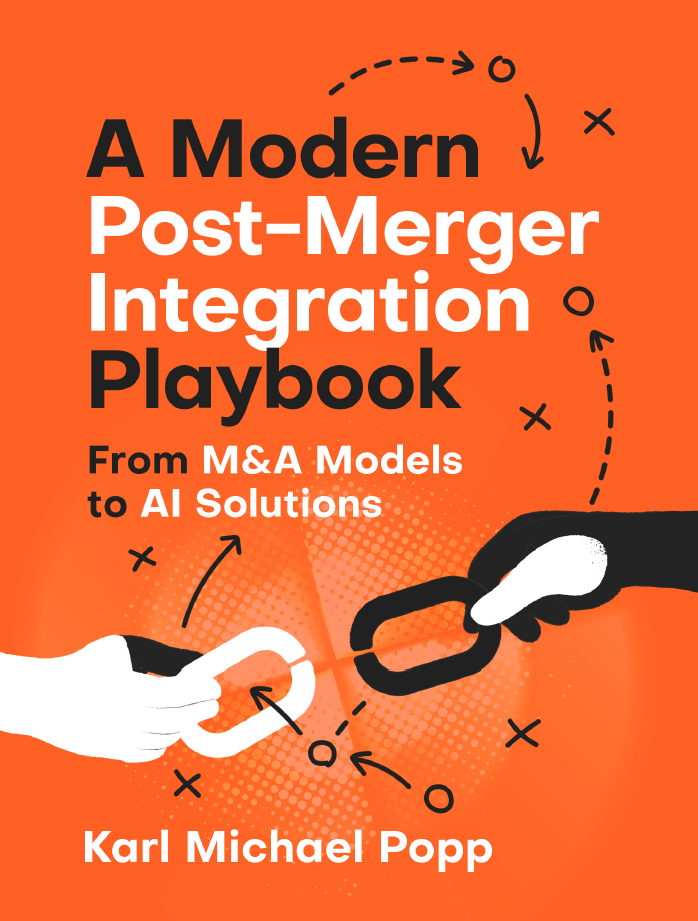
A Modern Post-Merger Integration Playbook: From M&A Models to AI Solutions
By Dr. Karl Michael Popp
Master integration due diligence to transform your M&A success. Learn more at manda-automation.com