Due Diligence: Business Model Due Diligence
THIS IS THE FREE, REDACTED VERSION OF THE TASKS IN THE M&A REFERENCE MODEL AND IT IS LICENSED UNDER Creative Commons Attribution-NonCommercial-ShareAlike 4.0 International THE FULL SET OF DATA HAS TO BE LICENSED COMMERCIALLY. https://www.manda-automation.com/free-reference-model/it-integration-fullThe task has the following goal(s):
Target business model: adjusted
Draft Business Model Integration Plan: prepared
The task has the following objectives:
Risk: minimized
Quality: maximized
Information asymmetry: minimized
Short description of task Business Model Due Diligence:
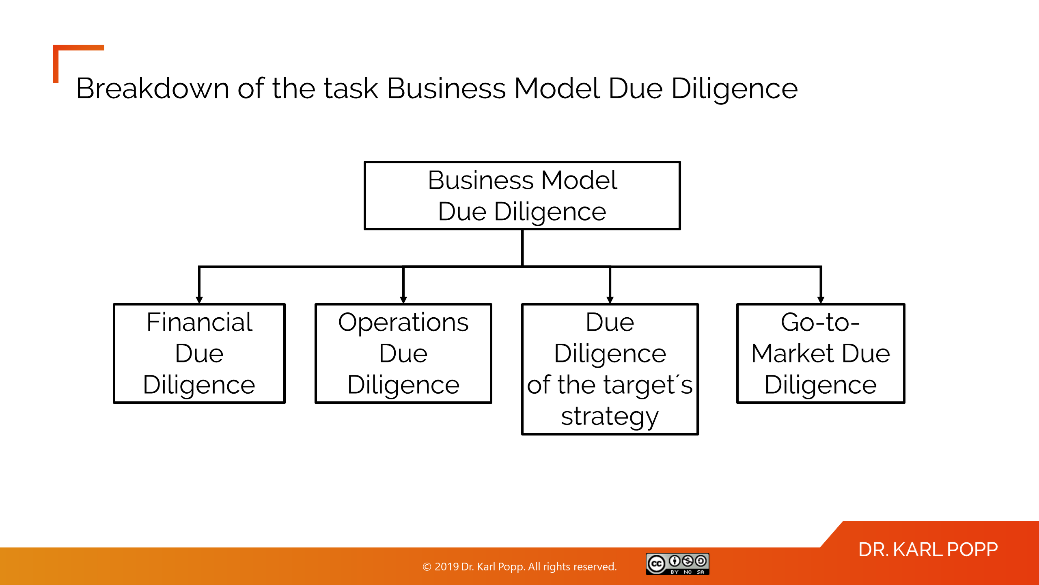
The target business model is analysed in detail and compared with the buyer business model. This is done in the subtasks of this task. The differences between the business models are documented and any steps that may be necessary for a potential integration are included in the draft business model integration plan.
The task uses the following business object types:
Target business model, Draft Business Model Integration Plan, Buyer business model, Business model difference, Target value proposition, Key activities of the target, Channel of the target, Structure of the target costs, Ecosystem, Key partners of the target,
Questions to be used during the execution of the task
The task is executed with the following questions, among others:
What are the target's products and services?
How do the target's products and services distinguish themselves from those of competitors?
What is the target's value proposition?
What are the target's customer segments?
What is the problem addressed by the target, what are the customers of the individual customer segments?
Which added value by solving problems do the products and services provide to customers?
Can it be assumed that the target's products and services will continue to be in demand by customers in the future?
What are the target's business models?
How is revenue generated?
How crisis-proof and scalable is the revenue model?
How is revenue distributed among the customer segments?
Which channels does the target company use to interact with customers (segments)?
On which digital channels does the target company interact with the customers (segments)?
Which partners does the target company work with?
What are the forms of partnerships with distribution partners?
Does the target operate a platform business model?
Which employees are indispensable for service delivery (key resources)?
Which technical resources are indispensable for service delivery (key resources)?
Which intellectual property is indispensable for service provision (Key Resources)?
Which partners are indispensable for service provision (Key Resources)?
What are the activities that are indispensable for service delivery and the value proposition of the target?
What is the cost structure of the business model and how do costs behave as the company grows?
Do the cost structure and revenue generation allow for a sustainable profit?
How can the business models of target and buyer complement each other?
Which synergies can result from the complementarities of the business models of target and buyer?
How does the value proposition of the target fit with the buyer?
How do the target's customer segments fit the buyer?
How do the problems addressed by the target fit the buyer?
Which joint added value by solving problems will the products and services of the target and the buyer offer customers in the future?
How does the way in which sales are generated suit the buyer?
How do the channels of interaction of the customer and the target with the customer fit together?
Can the buyer's products and services be sold through the target's channels?
Are the technical resources of the target and the buyer complementary?
Can the target's intellectual property be used by the buyer?
Which influence does the acquisition have on the cost structure of the buyer and target?
Are there complementarities between buyer and target in the partner ecosystem?
Which applications are used in modeling and controlling business models?
THIS IS THE FREE; REDACTED VERSION OF THE TASK IN THE M&A REFERENCE MODEL: THE FULL SET OF DATA HAS TO BE LICENSED(C) Dr. Karl Michael Popp 2025